
SEC Crypto Shift: From “Anything Could Be a Security” to Defined Categories
Crypto risk is starting to get priced differently

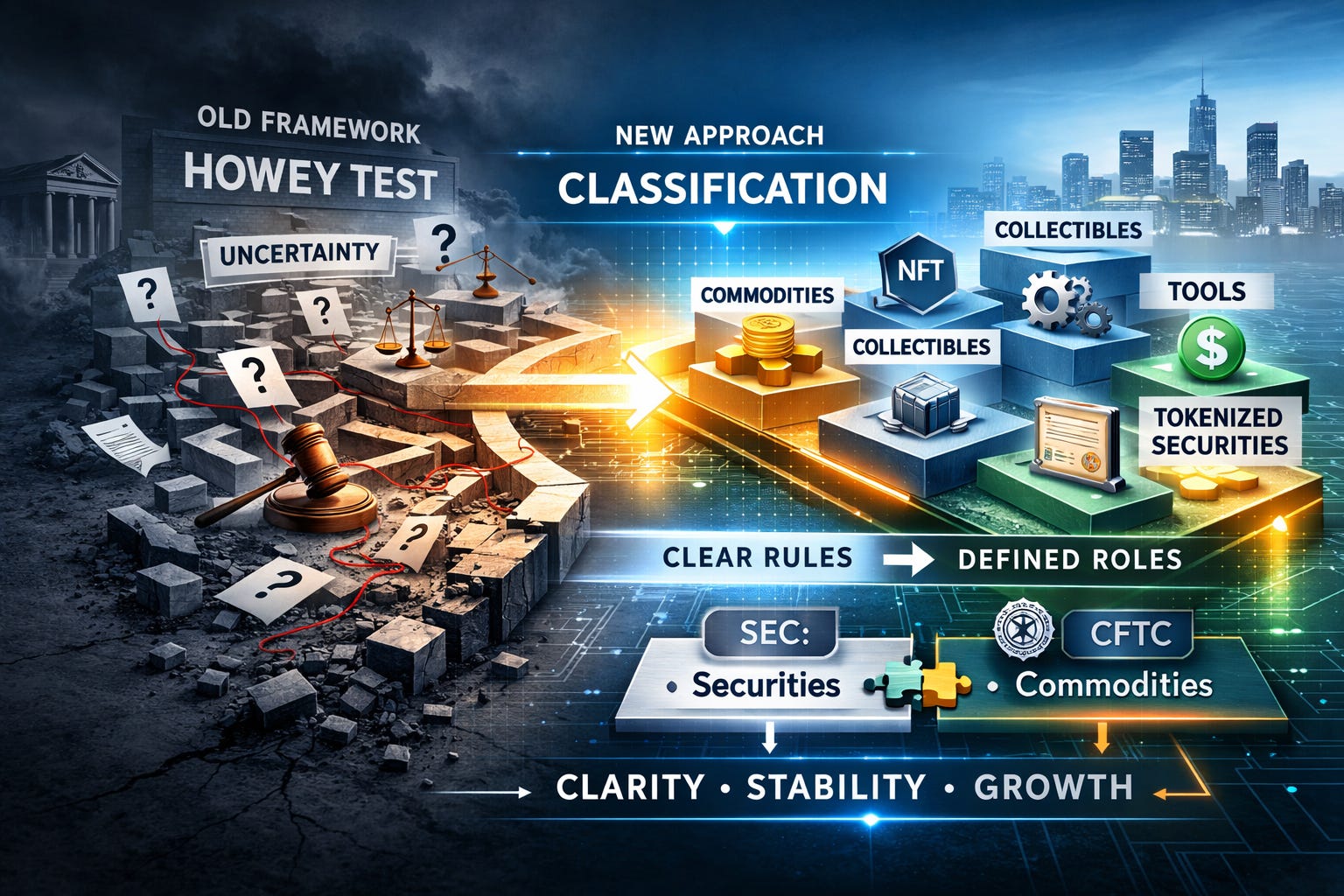
The SEC just clarified how federal securities laws apply to crypto assets and the transactions around them.
The shift is structural.
For years, the approach centered on the Howey test.
If buyers expected profits from someone else’s efforts, the asset fell under securities law. That expectation came from how the asset was presented.
Promises about development or future value tied to a team created the link. Buyers relied on that group to increase value. That reliance brought it under securities law.
In practice, outcomes depended on context. The same asset could be treated differently based on how it was positioned.
Analysis started with the transaction, not the asset.
Most of the market sat under potential securities treatment, with clarity coming through enforcement.
The new interpretation shifts away from that.
From Enforcement to Structure
The framework now begins with classification.
Assets are grouped by function:
digital commodities
digital collectibles
digital tools
stablecoins
tokenized securities
Some categories fall outside securities law. Others fall within it.
Identify the asset first, then evaluate the transaction.
This creates a more stable baseline for how different parts of the market are treated.
Not All Crypto Is the Same
Assets are separated by function.
Digital commodities depend on system operation and supply dynamics.
Digital collectibles relate to content or usage.
Digital tools provide access or utility.
Certain stablecoins function as payment instruments.
Tokenized securities map to traditional financial assets.
The market is no longer treated as a single regulatory category.
For investors, regulatory risk now varies across assets instead of applying uniformly.
Status Can Evolve
Investment contract analysis becomes conditional.
An asset can fall under securities law when tied to expectations about managerial effort. It can move out of that framework once those conditions fade.
Regulatory status can change as the system develops.
Time becomes part of the risk profile.
Core Network Activity Gets Defined
Several activities are clarified as non-securities:
protocol mining
protocol staking
wrapping of non-security assets
certain airdrops
These are core system functions.
The clarification reduces uncertainty around how networks operate.
Stablecoins as Infrastructure
Stablecoins under the GENIUS Act are not treated as securities.
They are framed as payment instruments.
Part of the market is being positioned as infrastructure, not as an investment layer.
Coordination Becomes Structural
The CFTC’s alignment points to a clearer split.
Non-security assets may fall under commodity definitions.
Tokenized securities remain under the SEC.
Hybrid systems still exist, but the direction is toward defined roles.
Oversight begins to match asset structure rather than react after the fact.
Takeaway
The shift changes how crypto risk should be read.
The starting point moves to what the asset is and how it functions.
Regulatory risk becomes uneven across the market.
Some assets move into clearer categories. Others remain exposed to how they are used and positioned.
Over time, that difference will shape how capital flows.
👉 Received this from someone else? Subscribe here.
ΔSignal
The only edge that matters is being early.
DeltaSignal shows the market setup before headlines
…………..
About DeltaSignal. DeltaSignal app surfaces quiet SEC disclosure changes, tracks filing order, and detects timing patterns tied to company actions. It captures company moves before narratives form and links every signal directly to the source.
DeltaSignal Substack. This Substack publishes selected, authorial research that reflects the analytical framework behind the DeltaSignal app.
Membership & Redistribution. Paid content is for private use only. Redistribution, reposting, or summarization in any form undermines the work and violates subscriber terms. Violations may result in removal of access.
Refund & Cancellation Policy. All DeltaSignal Substack subscription payments are final and non-refundable. Due to the digital content, no refunds are offered for any reason (e.g., change of mind, partial use, or dissatisfaction after access). Cancel anytime via your Substack settings; access continues until the current billing period ends, with no further charges. DeltaSignal reserves the right to terminate any subscription at its sole discretion, with or without prior notice.
Disclaimer. For informational purposes only. This content does not constitute financial, investment, or trading advice. Interpretations reflect analytical judgment based on public data, not recommendations or predictions. DeltaSignal is not affiliated with the SEC or any financial institution.
© AITrailblazer 2026